
 Kody Nexov
 Published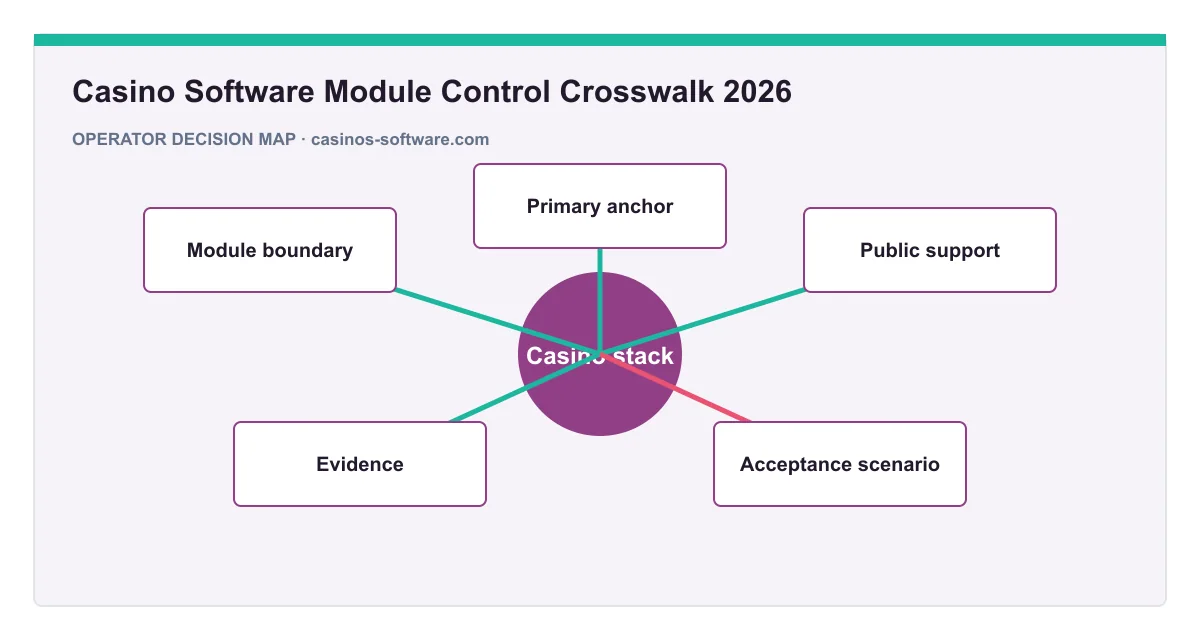
Original research - checked 2026-07-25
Research question
What must each casino software module prove at its boundary with player accounts, money, games, controls, and reporting?
Methodology
- Scope: the named product sample or control areas in the evidence matrix below.
- Sources: current official supplier pages, regulators, government standards, open standards, and testing guidance.
- Classification: Yes is explicit support; Partial is incomplete support; Not found is no evidence in the reviewed public source; Unknown is not evaluated.
- Checked: 2026-07-25. This is a point-in-time public-evidence record.
- No inference: a general standard does not prove a supplier implementation, and a missing public disclosure does not prove a missing capability.
Evidence matrix
| Module boundary | Primary anchor | Public support | Evidence | Acceptance scenario | Boundary | Primary source |
|---|---|---|---|---|---|---|
| Player account and session | GLI-19 and UKGC RTS | Yes | Identity, status, limits, access, session, event, and audit records | Open, restrict, suspend, and restore an account | Market rules determine exact controls | Gaming Laboratories International |
| Wallet and transaction reference | GLI-19 | Yes | Immutable identifiers, ledger events, adjustments, reconciliation, and approvals | Replay duplicate and failed money events | Accounting design remains product-specific | Gaming Laboratories International |
| RNG and game outcome | GLI-19 and approved testing | Yes | Game version, RNG test, configuration, approval, and release evidence | Verify approved version and outcome record | Testing requirement depends on market and game | UK Gambling Commission |
| Rules and information | UKGC RTS | Yes | Versioned game and promotion rules, display, effective date, and change evidence | Change a rule and verify player-facing consistency | Other markets may differ | UK Gambling Commission |
| Bonus and free spins | UKGC RTS | Partial | Eligibility, contribution, ordering, expiry, cancellation, disclosure, and ledger logic | Run award, use, expiry, cancellation, and dispute cases | Commercial mechanics remain product-specific | UK Gambling Commission |
| Jackpot management | GLI-19 | Yes | Contribution, pool, trigger, award, interruption, reconciliation, and reporting records | Interrupt and recover a jackpot event | Network and local models need separate scope | Gaming Laboratories International |
| Responsible-gambling tools | UKGC RTS | Yes | Limits, reality checks, exclusion, interaction, override, and audit evidence | Apply a control across all connected products | Applicable duties vary by market | UK Gambling Commission |
| Reporting and audit | GLI-19 | Yes | Transaction, game, account, adjustment, operator-action, and export records | Reconcile one day across modules | Regulatory report schemas are local | Gaming Laboratories International |
| Live dealer integration | GLI-19 | Partial | Round, stream, table, result, interruption, settlement, and dispute records | Interrupt a round and reconcile final state | Studio controls need separate evidence | Gaming Laboratories International |
| Game aggregation and release | UKGC testing strategy | Partial | Provider, title, version, market, certification, configuration, release, and rollback ledger | Withdraw and replace an affected game version | Aggregator and operator duties vary | UK Gambling Commission |
Findings
1. Money and game records must meet at stable references
Wallet, round, bonus, jackpot, adjustment, and report records need identifiers that support investigation and reconciliation.
2. A module is not an isolated feature
Every control has upstream data, downstream reporting, operator actions, failure behavior, and retained evidence.
3. Version and jurisdiction are part of the product
Game, rule, configuration, certificate, and market scope must be joined in release and audit records.
4. Live and aggregated content need interruption workflows
A normal happy-path integration does not prove settlement, correction, withdrawal, dispute, or recovery behavior.
How to use the evidence
- Remove fields that are not applicable to the target entity, market, product, and operating model; document why.
- Assign one accountable owner and one evidence artifact or test to every retained field.
- Keep Yes, Partial, Not found, and Unknown separate through RFP, demo, test, reference, and contract review.
- Convert supplier-specific gaps into versioned proposal, implementation, SLA, data, security, and exit schedules.
- Re-check source versions and effective dates before a procurement or launch decision.
Limitations
GLI-19 is a public testing-laboratory standard and UKGC material is a Great Britain regulatory anchor. Neither proves supplier compliance or replaces the rules, test strategy, certification, and reporting requirements of the target jurisdiction.
Primary sources
- Gaming Laboratories International - GLI-19 Interactive Gaming Systems v3.0 - A public interactive-gaming system control reference covering accounts, games, transactions, reporting, security, and operational controls.
- UK Gambling Commission - Remote gambling and software technical standards - Great Britain remote gambling software controls and current technical-standard verification questions.
- UK Gambling Commission - Testing strategy for remote gambling software - Testing, release, audit, change-control, and independent-assurance expectations for relevant Great Britain licensees.
- UK Gambling Commission - Approved test houses - The current regulator list of approved testing organizations for applicable Great Britain testing work.
Frequently asked questions
Does a Yes classification prove that a supplier complies?
No. Yes means the cited primary source explicitly supports the control or disclosure field. Supplier implementation still requires current product evidence and buyer verification.
Does Not found mean a capability is absent?
No. It means the reviewed public sources did not expose the evidence. Authenticated documentation, tests, proposals, or contracts may change the classification.
Can the CSV be used as an RFP starting point?
Yes, after adapting applicability, ownership, evidence, tests, and legal requirements to the target entity, jurisdiction, product, and operating model.
Concept map
Related concepts and decision guides
- Casino Software Module Research
- Use dated primary-source crosswalks and downloadable evidence matrices to turn software claims into buyer-owned verification tasks.
- transaction reference
- Define identifiers, idempotency, state transitions, failure behavior, and reconciliation evidence for casino game-round transactions.
- Casino Software Operations Library guide
- Navigate the specialist systems and operating controls behind an online casino product stack.
- Online Casino Platform Software
- Evaluate the platform layer that connects players, games, wallets, bonuses, and operations.
- Free Spins and Bonus Rules guide
- Design promotion logic that is clear to players and auditable for operators.
Evidence layer
Primary references and verification limits
Sources were checked on . They support the standards and verification questions used in this guide. They do not prove a supplier-specific price, market eligibility, implementation result, or private product claim; buyers should request current, versioned evidence for those points.
- Gaming Laboratories International - GLI-19 Interactive Gaming Systems v3.0 Testing-laboratory standard. A public interactive-gaming system control reference covering accounts, games, transactions, reporting, security, and operational controls.
- UK Gambling Commission — Remote gambling and software technical standards Regulator. Remote gambling software controls, security requirements, player-facing technical controls, and jurisdiction-specific verification questions.
- UK Gambling Commission — Testing strategy for remote gambling software Regulator. Testing, release control, audit evidence, change management, independent review, and production assurance questions.
- UK Gambling Commission - Approved test houses Regulator. The current regulator list of approved testing organizations for applicable Great Britain testing work.
- AWS Well-Architected — Reliability Pillar Cloud architecture guidance. Availability targets, resilience testing, incident learning, recovery objectives, capacity, and dependency management.
- NIST Cybersecurity Framework 2.0 Government standards body. Cybersecurity governance, risk management, protection, detection, response, and recovery outcomes.